 Quotes
 Invoicing
 Collections
 Recruiter
 Accounts payable
 Order intake
 Bookkeeping
 Scheduling
 Caregiver matching
 Crew dispatch
 Daily summary

The problem
The developer buys a lot, tears down the old house, builds a new one, and sells it, acting as its own general contractor. Anywhere from two to a dozen houses are under way at once, each with its own loan and its own draws.
The business isn’t big enough for a full-time bookkeeper, so it ran on part-time ones. Each left, the next had to be found and trained, and each kept the books a little differently. Things were done inconsistently, sometimes incorrectly. Most construction cost ended up in one catch-all account with the house attached but no cost type, card charges went in as monthly journal entries, one line per charge, and checks named the house only in a handwritten memo.
The owner is a builder, not an accountant. He needs to look at a charge, say which house and what kind of cost, and get back to building.
What we built
- Every transaction, coded. Each bank and card transaction comes in from QuickBooks, and the agent proposes the house and the cost type, with its reason and how sure it is. For a check, it reads the payee and the memo from the bank statement’s image.
- It learns. Once a vendor has been coded the same way three times, the next one is proposed with confidence. Words in a check’s memo learn their house. Every correction teaches it, and a settings page shows what it has learned, with a way to unlearn it.
- Green means approve. When the agent is at least 85% sure, the row is green, and one click approves every green row. The rest come to us with the question; the builder hears only the ones only he can answer.
- Loans, the way the lender keeps them. Draws, interest and fees added to the balance, and a month-end entry that brings the books to the lender’s statement, each approved before it posts.
- Closing a sale. When a house sells, its cost moves to cost of sale in one entry a person approves.
- Closed years stay closed. Nothing dated on or before the books’ closing date is proposed, coded, or changed.
- One screen for the owner. Cash in each bank account, and cost to date and loan balance for every house, read from QuickBooks as it reports them.
The books stay in QuickBooks. The tool never keeps figures of its own: every balance on the screen is QuickBooks’ own, with the time it was read.
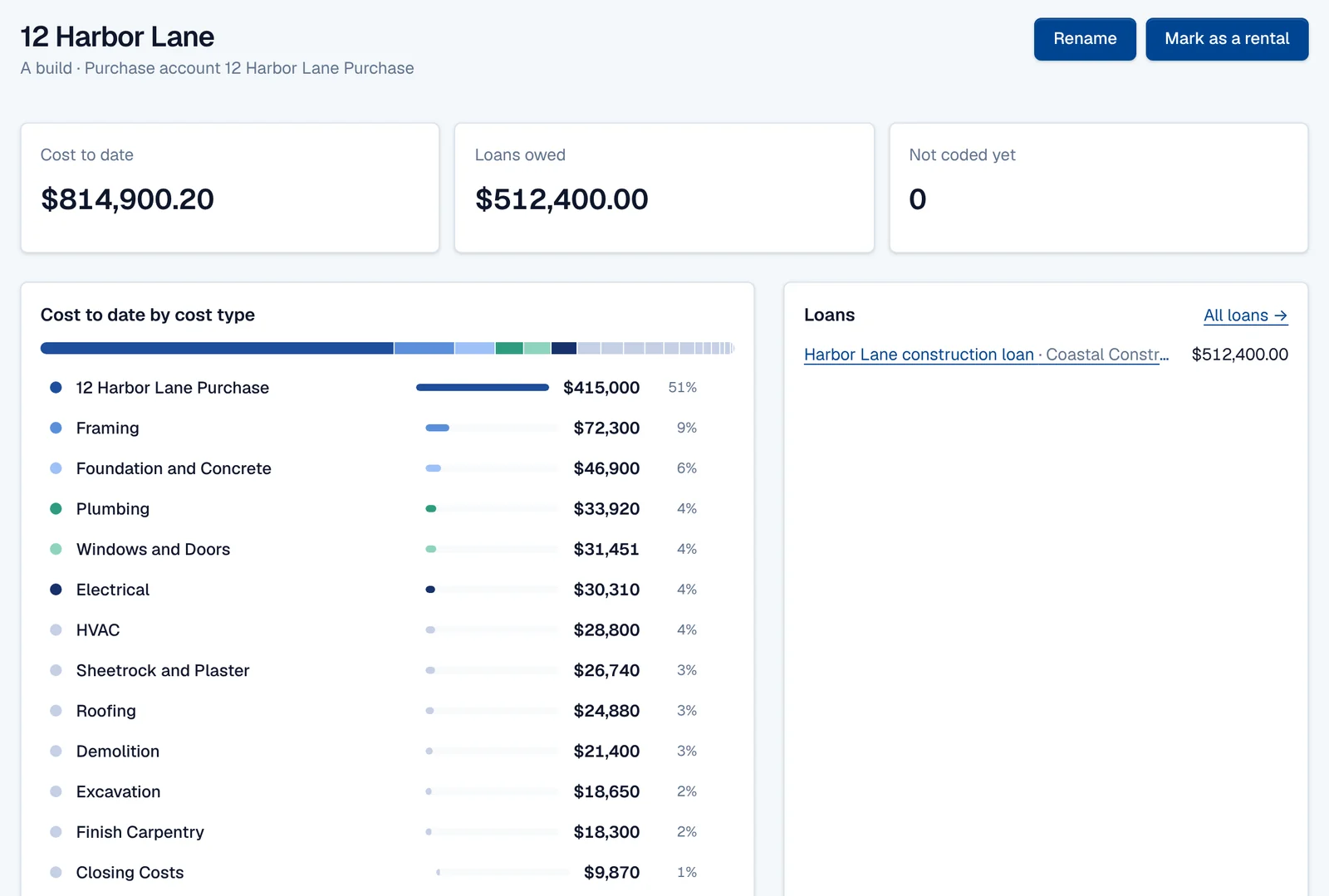
12 Harbor Lane
A build · Purchase account 12 Harbor Lane Purchase
Cost to date
$814,900.20
Loans owed
$512,400.00
Not coded yet
0
Cost to date by cost type
- 12 Harbor Lane Purchase$415,00051%
- Framing$72,3009%
- Foundation and Concrete$46,9006%
- Plumbing$33,9204%
- Windows and Doors$31,4514%
- Electrical$30,3104%
- HVAC$28,8004%
- Sheetrock and Plaster$26,7403%
- Roofing$24,8803%
- Demolition$21,4003%
- Excavation$18,6502%
- Finish Carpentry$18,3002%
- Closing Costs$9,8701%
Loans
All loans →
Harbor Lane construction loan · Coastal Constr…$512,400.00
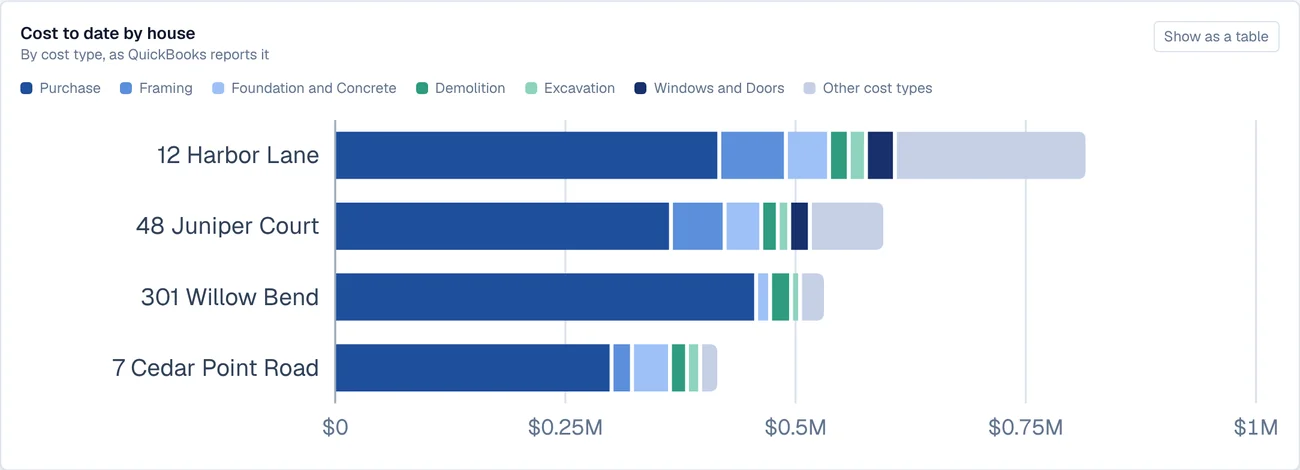
Cost to date by house
By cost type, as QuickBooks reports it
12 Harbor Lane
48 Juniper Court
301 Willow Bend
7 Cedar Point Road
What changed
The builder no longer manages a part-time employee or trains the next one. The books are kept the same way every month, coded to the house and the cost type, and the builder sees a short list of questions instead of a pile of statements.
Questions
Do you replace our CPA?
Does the agent post entries on its own?
Which accounting system does it work with?
Is the bookkeeping only for builders?
Every screen shows sample data. The company isn’t named here, and we’re glad to put you in touch: ask us for a reference.